|
In the year 1988 Ulla-Brita Palm worked in a Christina ecumenical radio station in Quito, Ecuador. She saw a lot of poor Indians and Mestises in the streets and got curious about how people at the bottom of society lived in the big city.
Her friends warned her for the danger of walking alone in the streets so she returned home without knowing anything about the poor people’s conditions of life.
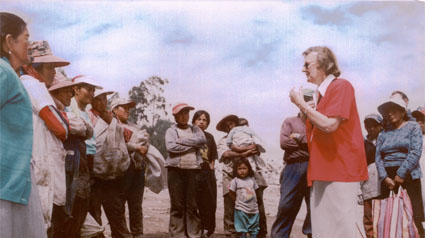
Ulla-Brita Palm returned to Quito in 1990 and did all that her friends had warned her to do. She made a risky trip to an Indian village deep in the jungle close to the Columbian border where no white woman had been before.
|
|
It was really blessed money. She found a doctor who joined in and who brought antibiotics for the sick children. She could buy fifty injections and medical equipment assisted by the doctor.
She also bought fifty pairs of boots to protect the women's feet for the glass at the dump. She could buy oil, rice and other staple food, pencils and paper for the children and �| of foremost importance �| scholarships ten children.
In 1991 on the International Women's day �| an article about the project was published. Many people willing to support financially contacted her. The foundation "Dump" was legally registered. More attention was given to her work as she was giving lectures about the project.
|
|
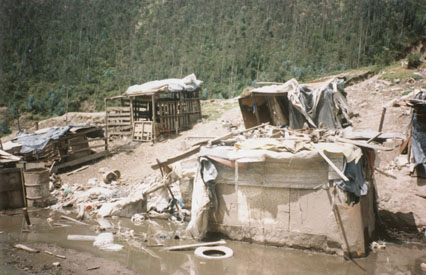
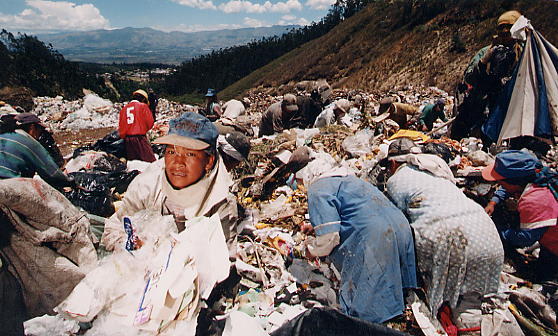
The Swedish Ambassador?s wife, Coty Manhusen, who she had got to know, told her that she used to go to a dump outside Quito to donate second hand clothes to the women who lived there. Ulla-Brita accompanied her and that experience completely changed her life. What she saw was horrifying. Dirty women with few teeth or no teeth at all with a baby tied to the stomach and a bigger child/baby tied to the back. The bigger children, scattered around their mothers, were dressed in rags and many of them were ill. Out of their infected ears pus was pouring. When the garbage trucks arrived the women rushed to them to dig for scrap materials they could use. It shocked her to see this as well as how they lived at the dump in small sheds.
Back home she decided to do something about it. She wrote an article about her experiences in the staff magazine at her working place, the Swedish Broadcasting Company, and made an appeal to her colleagues to give her used clothes.
She succeeded in collecting 100 kilos of textiles and 6000 Swedish Crowns (about 800 American Dollars), which she brought to Quito.
|
|
In 1991 she was invited by the Lord Mayor of Quito to the President's Palace.
She went there with the intention to realize her great plans.
She had a dream of building a center for the women and children.
In February 1992 the work started. Four months later it was completed and inaugurated with great ceremonies. It was one of the happiest days of her life.
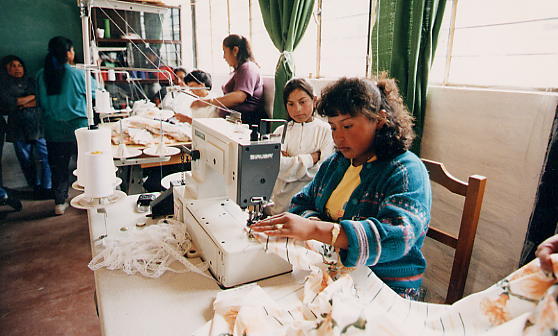
Today there is seething life in the center. You find well-equipped sewing facilities with fifteen industrial sewing machines where the women are taught to sew under professional leadership.
There is also a nursery for a hundred children, a kindergarten and a department for newborn babies.
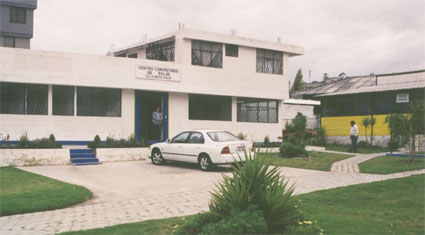
A medical center has also been built.
|